Bristled Attachments vs Traditional Pads: Which Cleans Better?
Introduction
Maintaining clean and attractive floors requires more than routine cleaning. The effectiveness of any floor maintenance program depends heavily on the tools used during the process. For decades, traditional floor pads have been the standard choice for scrubbing, polishing, and restoring various surfaces. However, advances in floor maintenance technology have introduced bristled attachments that offer a different approach to cleaning.
Facility managers, janitorial contractors, and maintenance teams are increasingly comparing these two options to determine which delivers better results. While both systems are designed to clean floors, they operate differently and often perform better under specific conditions.
Understanding the strengths and limitations of each approach helps maintenance professionals choose equipment that improves efficiency, extends floor life, and reduces long-term operating costs. The answer is not always straightforward because floor type, traffic conditions, and cleaning objectives all influence performance.
How Traditional Pads Work
Traditional floor pads rely on surface contact and friction to clean, scrub, polish, or strip flooring materials. These pads are manufactured using synthetic fibers combined with abrasive particles that provide varying levels of cleaning aggression.
When attached to a floor machine, the pad rotates against the floor surface, creating friction that loosens dirt, removes marks, and improves appearance. Different colors and densities are available to support specific maintenance tasks, from light polishing to heavy-duty stripping.
A Floor Polisher Pad is commonly used when operators want to enhance floor appearance while maintaining smooth contact with the surface. These pads perform effectively on flat flooring materials where contamination remains primarily on the surface layer.
Traditional pads have remained popular because they are simple to use and widely available. Their lightweight design allows quick replacement and compatibility with many floor machines.
However, their cleaning performance often depends on maintaining full contact with the floor. On uneven or textured surfaces, the pad may glide over low spots, leaving debris trapped in grout lines, grooves, or surface imperfections.
How Bristled Attachments Work
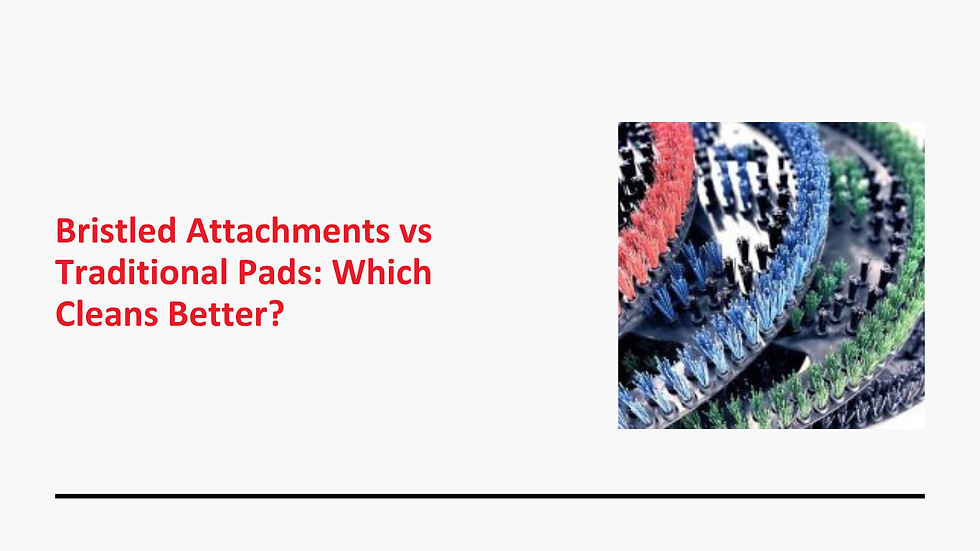
Bristled attachments approach floor cleaning differently. Instead of relying primarily on friction, they use thousands of flexible bristles that actively engage the floor surface.
As the machine rotates, the bristles penetrate textured surfaces, grout lines, and uneven floor profiles. This allows them to reach areas that conventional pads may not fully contact. The individual bristles continuously flex during operation, helping dislodge dirt and debris from difficult-to-clean areas.
Unlike flat cleaning systems, bristled attachments maintain cleaning action even when surface irregularities are present. This makes them particularly useful on textured tile, safety flooring, concrete, and industrial surfaces.
Many bristled systems are designed to resist clogging and maintain performance over extended periods. Because debris moves between the bristles rather than accumulating across a flat surface, cleaning effectiveness often remains consistent throughout longer work cycles.
This design has made bristled attachments increasingly popular in facilities where deep cleaning and surface recovery are ongoing priorities.
Cleaning Performance Head-to-Head
When comparing cleaning performance directly, the most important factor is the type of floor being maintained.
On smooth, highly finished floors, traditional pads often provide excellent results. Their full-surface contact allows them to polish evenly and create a consistent appearance. For routine maintenance in office buildings or polished environments, they continue to perform well.
However, challenges arise when dirt becomes embedded below the immediate surface. Grout lines, textured flooring, and uneven surfaces frequently retain contamination that flat pads cannot fully reach.
Bristled attachments typically excel in these situations. Their ability to penetrate surface irregularities allows them to remove embedded dirt more effectively. In heavily trafficked commercial spaces, this deeper cleaning action often improves overall floor appearance and cleanliness.
Testing conducted in many maintenance environments shows that bristled systems frequently require fewer repeated passes to achieve desired cleaning results. This can reduce labor time and improve productivity.
While traditional pads remain effective for surface-level maintenance, bristled systems generally provide an advantage when deep cleaning and contaminant removal are priorities.
Durability, Maintenance and Ease of Use
Durability is one of the most important factors influencing long-term maintenance costs. Tools that wear out quickly increase replacement frequency and create operational interruptions.
Traditional pads gradually lose thickness as fibers break down through use. Their abrasive particles also become less effective over time. In demanding environments, replacement cycles can become frequent.
Bristled attachments often maintain cleaning performance longer because the bristles continue functioning even after extended use. Rather than wearing evenly across a flat surface, individual bristles retain their cleaning ability over many operating hours.
Maintenance requirements also differ. Traditional pads frequently accumulate debris within their fibers, requiring cleaning or replacement to restore effectiveness. Bristled systems generally shed debris more efficiently, helping maintain consistent performance.
Ease of use depends on operator familiarity. Many maintenance teams are accustomed to traditional pads and appreciate their simplicity. Bristled systems may require slight adjustments in technique, but once operators become familiar with them, the learning curve is usually minimal.
From a durability perspective, bristled attachments often offer a longer service life in demanding environments.
Cost, Labor and Sustainability
Initial purchase price is often the first consideration when selecting floor maintenance tools. Traditional pads generally have lower upfront costs, making them attractive for budget-conscious operations.
However, evaluating total ownership cost provides a more complete picture. Frequent pad replacement increases long-term expenses and requires additional labor for changing consumables. Over time, these costs can become substantial in large facilities.
Pads for Floor Buffer equipment remain widely used because of their affordability and versatility, but replacement frequency often affects overall operating budgets.
Bristled attachments typically involve a higher initial investment. Yet their extended lifespan can offset these costs through reduced replacement needs and fewer maintenance interruptions.
Labor efficiency also plays an important role. If a cleaning system requires fewer passes and achieves better results more quickly, maintenance teams can complete work faster and allocate resources elsewhere.
Sustainability considerations further influence purchasing decisions. Longer-lasting tools reduce waste generation and decrease the volume of discarded consumables entering landfills. Facilities pursuing environmental goals often view this reduction as an additional benefit.
When evaluating cost, labor, and sustainability together, many organizations find that long-life systems provide stronger value over extended maintenance cycles.
Conclusion & Recommendation
The comparison between bristled attachments and traditional pads ultimately depends on cleaning objectives and floor conditions.
Traditional pads remain effective for routine maintenance, polishing, and appearance enhancement on smooth surfaces. They are familiar, affordable, and easy to implement across many maintenance programs.
Bristled attachments offer advantages in deep cleaning, textured flooring maintenance, grout cleaning, and contaminant removal. Their ability to reach below the immediate surface often results in more thorough cleaning and improved efficiency.
For facilities focused primarily on maintaining smooth finished floors, traditional pads may continue to meet operational requirements. However, organizations seeking deeper cleaning performance, reduced replacement frequency, and improved long-term productivity often benefit from adopting bristled systems.
Many modern maintenance programs now use both technologies strategically, selecting the most appropriate tool based on floor type and cleaning objectives rather than relying exclusively on a single solution.
Choosing the right system is less about replacing one technology with another and more about matching the cleaning method to the demands of the environment.
Frequently Asked Questions (FAQs)
Are bristled attachments better than traditional floor pads?
Bristled attachments often provide deeper cleaning on textured surfaces and grout lines, while traditional pads perform well on smooth flooring.
Which option lasts longer during commercial floor maintenance?
Bristled attachments generally offer a longer service life and maintain performance over extended operating periods.
Can traditional pads still be used for polishing floors?
Yes. Traditional pads remain a popular choice for polishing and maintaining smooth finished surfaces.
Do bristled systems reduce labor time?
In many cases, yes. Their ability to clean deeply and efficiently often reduces the number of passes required.
Are bristled attachments suitable for industrial facilities?
Yes. They are commonly used in warehouses, manufacturing facilities, retail spaces, and other environments with heavy floor contamination.


Comments